Odoo vs Salesforce for Mid-Sized Businesses: Which CRM Offers Better Value in 2026?
If you are comparing Odoo and Salesforce for a mid-sized business, the short answer is this: Salesforce is the more powerful platform for large enterprises with complex sales operations and dedicated administrators, while Odoo CRM tends to offer better value for mid-sized companies that want a practical, affordable CRM connected to the rest of their business sales, website, marketing, invoicing, accounting, and support in one system. Salesforce is one of the most established names in CRM. For large enterprises with layered approval flows, advanced automation requirements, and system administrators, it can be a powerful platform. But mid-sized businesses often need something different: a CRM that helps sales teams move faster, follow up better, manage opportunities clearly, and connect customer data across the business without too much cost or complexity.
They need a system strong enough to support growth, but practical enough for daily use. That is where Odoo CRM becomes a compelling alternative. Odoo CRM gives mid-sized businesses the tools to manage leads, opportunities, follow-ups, quotations, forecasting, and reporting and it sits inside a wider suite of connected apps, letting CRM work alongside Website, Sales, Email Marketing, Helpdesk, Invoicing, Accounting, and Inventory.
Odoo vs Salesforce at a Glance
In short: Salesforce is a specialized, best-in-class CRM built for sales automation at scale, with mature AI (Agentforce and Einstein) and a huge integration ecosystem but it carries higher cost and complexity. Odoo is a full business suite that includes CRM, so a mid-sized team gets sales, invoicing, accounting, inventory, and support in one connected, lower-cost system. Choose Salesforce for enterprise-grade sales depth; choose Odoo for connected value and simpler adoption.
The quickest way to see the difference is by factor. On scope, Salesforce is a specialized CRM while Odoo is an integrated ERP-plus-CRM suite. On pricing, Salesforce Sales Cloud runs per user from about $25 (Starter) to $175 (Enterprise) and higher, while Odoo bundles all apps into one plan (around $31/user/month in the US Standard plan) with a free option. For businesses in Asia Pacific (APAC), Odoo pricing averages around $15.00 per user per month, making it an even more cost-effective option in the region. On AI, Salesforce offers mature Agentforce and Einstein features while Odoo includes practical AI lead scoring. On ease of adoption, Odoo's simpler, more connected workflow is often easier for lean teams to roll out, while Salesforce's enterprise structure can need more configuration and training.
What Is Salesforce Sales Cloud?
Salesforce Sales Cloud is an enterprise-grade CRM built for sales automation at scale. It handles lead, account, contact, and opportunity management, pipeline visibility, forecasting, AI-assisted features, and automation across multiple plan tiers. It is a strong fit for large organizations with advanced requirements and dedicated teams to manage implementation and customization.
This makes Salesforce a strong option for large organizations with advanced CRM requirements and dedicated teams to manage implementation, administration, and ongoing customization. However, that level of enterprise power can also make Salesforce feel heavy for mid-sized companies. The platform can require more configuration, more training, more add-ons, and more ongoing management than a leaner sales team may expect.
For a mid-sized business, the question is not whether Salesforce is capable it clearly is. The better question is whether the business needs that much system, cost, and complexity to achieve its sales goals.
What Is Odoo CRM?
Odoo CRM is a sales management application within Odoo's open-source suite of connected business apps. It helps teams organize leads, track opportunities, manage pipeline stages, schedule activities, create quotations, review forecasts, and monitor performance and because it is part of a wider suite, CRM connects directly to Website, Sales, Invoicing, Accounting, and Helpdesk.
Odoo's advantage is that CRM is not isolated from the rest of the business. A lead can come from an Odoo website form, move into the CRM pipeline, turn into a quotation, become a sales order, proceed to invoicing, and continue into customer support.
For mid-sized companies, this matters because growth often creates operational gaps. Sales, marketing, finance, and support teams may begin using different systems, separate spreadsheets, and disconnected reporting tools. Odoo helps reduce that fragmentation by giving the business a more connected operating environment.
Why Do Mid-Sized Businesses Struggle With Too Many Systems?
Mid-sized businesses often outgrow basic tools but find enterprise software too costly or complex. As leads arrive from more channels and teams grow, they adopt a powerful CRM, then discover they still need separate tools for marketing, website forms, support, quoting, and reporting. Each added tool brings another subscription and another place where customer data becomes disconnected.
Many mid-sized businesses reach a point where basic tools are no longer enough, but enterprise software feels too expensive or too complicated. Leads are coming from more channels. Sales teams are growing. Managers need better visibility. Customers expect faster responses. Leadership wants cleaner reports. This is usually when businesses start looking for a CRM.
The risk is choosing a platform that solves one problem while creating several new ones. A company may adopt a powerful CRM, then later realize it needs separate tools for marketing automation, website forms, customer service, e-signatures, quoting, reporting, or integrations. Each added tool brings another subscription, another workflow, and another place where customer data can become disconnected. Odoo approaches this differently instead of treating CRM as one separate system, Odoo CRM can become part of a unified business workflow.
Why Is Unified Data a Major Advantage?

Unified data is a major advantage because it removes the 'integration tax' the time and cost of syncing separate systems, mapping fields, and fixing duplicate records. In Odoo, CRM, Website, Sales, Email Marketing, and Helpdesk share customer information within one ecosystem, giving teams a clearer view of the full customer journey from first inquiry to closed deal to post-sale support.
In many organizations, sales data, marketing data, website data, and customer support data are spread across different platforms. Even when these tools are integrated, the business still has to manage syncing, mapping, duplicate records, broken workflows, and inconsistent reporting. This creates what many teams experience as an “integration tax” the business pays not only for software, but also for the time, effort, and technical support needed to keep separate systems aligned.
With Odoo, related apps are designed to work within the same ecosystem. CRM, Website, Sales, Email Marketing, Helpdesk, and other apps can share customer information more naturally. For mid-sized businesses with lean teams, this can make a major difference: less time is spent reconciling data, and more time is spent acting on it.
Which CRM Is a Better Fit for Lean Sales Teams?
For lean sales teams, Odoo CRM is often the easier fit. Its visual pipeline lets reps schedule calls, meetings, mailings, and quotations while managers review expected revenue and activity without heavy configuration or long training cycles. Salesforce offers strong pipeline and forecasting tools too, but its enterprise structure can feel more complex than a mid-sized team needs day to day.
Mid-sized sales teams need tools that support momentum. They do not always have time for complex workflows, heavy configuration, or long training cycles. Odoo CRM keeps the sales workflow clear: opportunities can be managed through a visual pipeline, salespeople can schedule calls, meetings, mailings, and quotations, and managers can review expected revenue, team activity, and pipeline progress.
Salesforce also provides strong pipeline and forecasting tools, but its broader enterprise structure can feel more complex than what some mid-sized teams need. For organizations that want practical CRM adoption across sales users, Odoo's simpler and more connected approach can be easier to roll out and maintain. A CRM only works when the team actually uses it. Odoo gives sales teams a practical reason to keep the system updated because it supports the work they already need to do.
How Do Odoo and Salesforce Compare on Pricing?
Salesforce Sales Cloud is priced per user, per month, mostly billed annually: roughly $25 (Starter Suite), $100 (Pro Suite), $175 (Enterprise), and $350 (Unlimited) in 2026, with an Agentforce 1 Sales tier around $550. Odoo bundles all apps into one plan at about $31 per user/month for the US Standard plan plus a One App Free option and a free, self-hosted Community Edition. Odoo prices also vary by region. Odoo prices also vary by region. In Asia Pacific (APAC), Odoo pricing offers a significant advantage, averaging around $15 per user per month.
Cost is one of the biggest considerations for mid-sized businesses. Salesforce uses multiple Sales Cloud plan tiers, with increasing levels of AI, automation, integration, forecasting, and customization depending on the edition. As of 2026, those tiers run roughly $25 per user/month for Starter Suite, $100 for Pro Suite, $175 for Enterprise (where most mid-market teams land), and $350 for Unlimited, with an AI-focused Agentforce 1 Sales tier around $550; Salesforce raised Enterprise and Unlimited prices about 6% in late 2025. That gives businesses options, but it can also make costs rise as teams need more users, more advanced features, or additional tools.
Odoo's pricing model is easier for many businesses to understand. Odoo offers a One App Free option for one app with unlimited users, and its paid plans include access to all apps under a single user-based subscription. Odoo's Standard plan is around $31 per user/month in the US (annual, all apps), with a Custom plan (roughly $47–61) adding Studio, external API, and multi-company support; a free, self-hosted Community Edition is also available. Because Odoo prices regionally, rates in the Philippines and wider APAC are often lower than US figures. A key difference: Salesforce gates many features (AI, advanced automation, API access) behind higher tiers or paid add-ons, while Odoo includes its apps in one plan so for a mid-sized team needing CRM plus other functions, Odoo's total cost is often several times lower over a comparable feature set. For a mid-sized business trying to control software spend while improving operations, Odoo offers a more affordable path to growth.
Note on figures: these are 2026 US pricing rates from Salesforce and Odoo published pricing and third-party pricing trackers. Salesforce uses quote-based pricing above Starter, and both vendors change rates and vary by region, so verify on each official pricing page before publishing.
How Does Odoo Connect Lead, Quote, Invoice, and Support?
Odoo connects the full customer journey inside one system: a lead becomes an opportunity, then a quotation, then a sales order, then an invoice, and later a support case all sharing the same data. When these steps live in separate systems, sales loses visibility after closing, support can't see sales history, and finance waits on manual updates. Odoo keeps them linked.
For many companies, CRM is only the start of the customer journey. A lead becomes an opportunity. An opportunity needs a quotation. A quotation becomes an order. An order leads to billing. A customer may later need support. When these steps happen across different systems, teams lose time and visibility sales may not know what happened after closing, support may not see the customer's sales history, and finance may need to wait for manual updates.
Odoo helps connect these steps more clearly. CRM can work with Sales, Invoicing, Website, Email Marketing, and Helpdesk, making it easier for teams to manage the customer journey from one place. For mid-sized businesses, this can improve both internal efficiency and customer experience.
Why Is Odoo a Strong Choice for Mid-Sized Businesses?
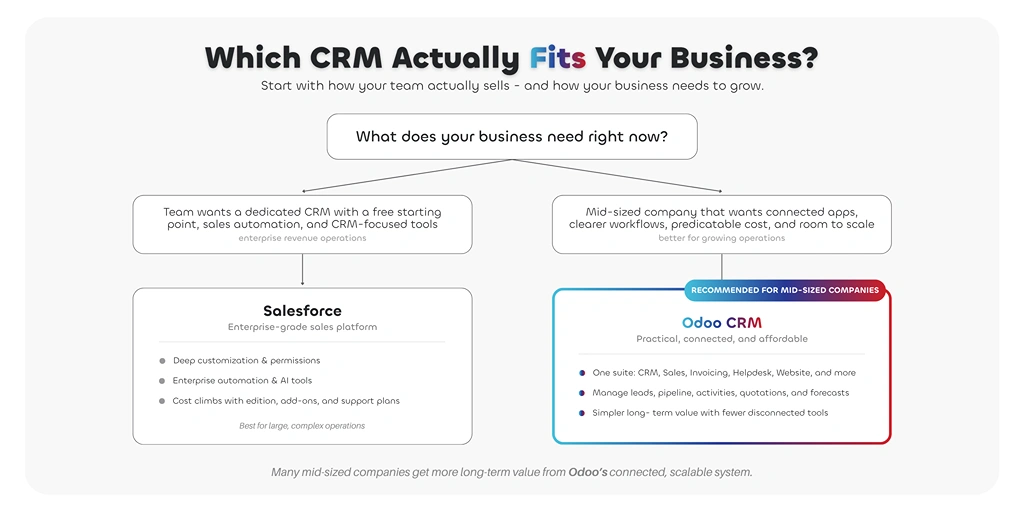
Odoo is a strong fit for mid-sized businesses that want a practical, efficient, and affordable CRM that also reduces the need for disconnected software. Salesforce remains excellent for enterprises with complex sales operations and the budget for a highly customized environment but mid-sized teams often get more value from Odoo's connected, lower-cost approach.
Salesforce remains a strong platform, especially for enterprise organizations with complex sales operations and the budget to support a highly customized CRM environment. Odoo CRM is the stronger fit for mid-sized businesses that want a practical, efficient, and affordable system. It gives teams the CRM tools they need while reducing the need for disconnected software, and it gives businesses room to expand into other operational apps without moving to a separate platform for every new function.
Mid-sized businesses should consider Odoo CRM if they want:
- A clearer sales pipeline.
- Better follow-up management.
- A more affordable CRM setup.
- A connected path from lead to quotation to invoice.
- Less dependence on separate tools and integrations.
- A system that can grow with the business without becoming too heavy too soon.
How Do You Get the Most Out of Odoo CRM?
Odoo CRM works best when it is set up around how the business actually sells configuring pipeline stages, lead sources, activity types, reporting views, user roles, and connected workflows to match the team's real process. This is where an implementation partner adds the most value, turning a generic install into a system the team will actually use.
Like any CRM, Odoo works best when it is set up around the way the business actually sells. The pipeline stages, lead sources, activity types, reporting views, user roles, and connected workflows should reflect the team's real process. That is where Kpability helps. Kpability helps businesses implement Odoo CRM with the right structure, workflows, and reporting setup. The goal is not just to install a CRM it is to build a system that helps the team manage leads, follow up consistently, see opportunities clearly, and connect sales activity with the rest of the business.
Frequently Asked Questions (FAQ)
Is Odoo cheaper than Salesforce?
Usually yes, especially when you compare included features rather than headline prices. Odoo's Standard plan (about $31/user/month in the US) includes every app, all integrations, and built-in automation, while Salesforce starts at $25/user/month but gates AI, advanced automation, and API access behind higher tiers or paid add-ons. Odoo prices in Asia Pacific (APAC) offer a significant advantage, averaging at $15.00 per user per month. For a mid-sized team needing CRM plus other functions, Odoo's total cost is often several times lower over a comparable feature set. Verify current rates on each vendor's pricing page.
Is Odoo better than Salesforce?
Neither is universally better it depends on your needs. Salesforce is better for large enterprises with complex sales operations, big teams, and dedicated administrators who need best-in-class sales automation and AI. Odoo is better for mid-sized businesses that want an affordable, connected system covering CRM plus sales, invoicing, accounting, and support in one place.
What is the difference between Odoo and Salesforce?
The core difference is scope. Salesforce is a specialized, best-in-class CRM focused on sales. Odoo is a full open-source business suite (ERP) that includes CRM alongside sales, website, invoicing, accounting, inventory, and support. With Salesforce you add other functions through separate products or third-party apps; with Odoo they are built into one connected system.
Can Odoo replace Salesforce?
For many mid-sized businesses, yes. Odoo CRM covers the core sales work most teams need leads, opportunities, pipeline, quotations, forecasting, and reporting and connects it to the rest of the business. Very large organizations with highly complex, high-volume sales operations or deep Salesforce customizations may still prefer Salesforce, but mid-sized teams can often replace it with Odoo at a lower total cost.
Is Salesforce only for large enterprises?
No. Salesforce serves businesses of many sizes, and its Starter and Pro suites target smaller teams. But its greatest strengths advanced automation, deep customization, and mature AI are most valuable when CRM is central to a complex, high-growth sales operation, which is why it is often associated with enterprises.
Does Odoo CRM include AI and automation?
Yes. Odoo CRM includes AI lead scoring to help prioritize leads, plus automation for lead creation, assignment, scheduled activities, and follow-ups included in the standard plan. Salesforce offers more mature AI through Agentforce and Einstein, though those capabilities typically sit in higher tiers or paid add-ons.
How does Kpability help with Odoo CRM implementation?
Kpability helps mid-sized businesses implement Odoo CRM with the right structure, workflows, and reporting configuring pipeline stages, lead sources, activity types, user roles, and connected apps around the team's real sales process. The goal is a system the team actually uses, with sales activity connected to the rest of the business.
The Bottom Line
Salesforce is powerful, but not every mid-sized business needs an enterprise-heavy CRM to manage sales well. Odoo CRM gives mid-sized companies a more practical and cost-efficient way to manage leads, opportunities, follow-ups, quotations, reporting, and customer workflows. Its biggest advantage is that it does not stop at CRM it can connect sales with website activity, marketing, invoicing, helpdesk, and other business processes in one ecosystem. For mid-sized businesses that want to improve sales visibility without increasing software complexity, Odoo CRM is a smart and scalable choice.

Related posts

Odoo vs Salesforce for Mid-Sized Businesses: Which CRM Offers Better Value in 2026?
If you are comparing Odoo and Salesforce for a mid-sized business, the short answer is this: Salesforce is…

Omnichannel Is Not About Being Everywhere. It Is About Being Connected
Knect for Modern Businesses: Why Omnichannel Means Staying Connected For many modern businesses, omnichannel sounds like a race…

Why Customer Conversations Break When Channels Do Not Work Together
Knect, Powered by Odoo: Why Customer Conversations Break Across Channels Customer conversations no longer happen in a straight…