
Zoho CRM vs Odoo CRM: Which Is Better for Growing Businesses in 2026?
If you are comparing Zoho CRM and Odoo CRM, the short answer is this: Zoho CRM is the stronger choice for teams that want a dedicated, sales-focused CRM with a free entry point and deep automation, while Odoo CRM is the better fit for growing businesses that want a CRM connected to a wider suite of business apps sales, website, marketing, invoicing, accounting, and support under one system. Zoho CRM is one of the more familiar names in the CRM market, especially for small and mid-sized businesses looking for a sales platform with automation, lead management, reporting, and built-in productivity tools. But the more useful question is not which platform has more features on paper; it is which CRM gives your team the clearest, most cost-efficient path to manage leads, opportunities, follow-ups, reporting, and future growth.
Zoho CRM vs Odoo CRM at a Glance
In short: Zoho CRM suits sales-led teams that want an affordable, dedicated CRM with strong automation and the Zia AI assistant. Odoo CRM suits businesses that want their CRM connected to sales, invoicing, accounting, and support in one integrated system. Choose Zoho for CRM depth; choose Odoo for connected, end-to-end business workflows.
The quickest way to see the difference is by factor. On pricing, Zoho starts free for up to three users while Odoo offers One App Free for unlimited users on a single app. On AI, Zoho relies on Zia (from its Enterprise tier upward) while Odoo includes built-in AI lead scoring. On pipeline management, both offer Kanban views, though Odoo's drag-and-drop pipeline is a standout. On ecosystem, Zoho connects 50+ apps while Odoo's CRM sits natively inside a full ERP-style suite spanning Sales, Website, Invoicing, Accounting, Inventory, and Helpdesk. And on scale, Zoho grows through higher CRM editions and Zoho One, while Odoo grows into full business operations under a single subscription.
What Is Zoho CRM?
Zoho CRM is a cloud-based customer relationship management platform built to help businesses manage leads, contacts, deals, sales activities, automation, reporting, and customer engagement. It offers a Free Edition for up to three users plus four paid tiers, and includes Zia, Zoho's AI assistant, on higher editions.
Zoho CRM includes features such as lead management, deal tracking, workflow automation, sales forecasting, process management, AI assistance through Zia, and integrations across the Zoho ecosystem of 50+ business apps. This makes it a capable platform for teams that want a dedicated CRM with sales and marketing automation features.
For small teams, Zoho CRM can be a practical way to move away from spreadsheets. For more mature teams, its higher editions offer deeper automation, AI, territory management, customer portals, and process tools.
What Is Odoo CRM?
Odoo CRM is a sales management application within Odoo's open-source suite of connected business apps. It helps teams track leads, organize opportunities by pipeline stage, schedule next actions, create quotations, and analyze sales, and it can expand into Sales, Website, Marketing, Invoicing, Accounting, Inventory, and Helpdesk as needs grow.
The difference is that Odoo CRM is part of a wider suite of connected business applications. Businesses can start with CRM, then expand into Odoo Sales, Website, Email Marketing, Helpdesk, Invoicing, Accounting, Inventory, Project, and other apps as their needs grow.
This matters because customer relationships rarely stay inside the CRM alone. A lead may come from a website form, become an opportunity, turn into a quotation, move into a sales order, generate an invoice, and later require customer support. With Odoo, more of this journey can be handled within one connected environment reducing manual work, scattered tools, and disconnected customer information.
How Much Do Zoho CRM and Odoo CRM Cost?
Zoho CRM starts free for up to 3 users, with paid tiers from about $14 to $52 per user/month (annual, US). Odoo offers One App Free for unlimited users on a single app; its Standard plan, which includes all apps, is about $31 per user/month in the US. Odoo prices vary significantly by region, so rates in the Philippines and wider APAC are often lower.
Zoho CRM has a strong free starting point for very small teams. Its Free Edition is available for up to three users and includes essential CRM tools such as leads, deals, workflows, reports, reminders, tasks, meetings, calls, and mobile access. As of 2026, Zoho's paid editions in the US run roughly $14 per user/month for Standard, $23 for Professional, $40 for Enterprise (the tier where Zia AI unlocks), and $52 for Ultimate, all on annual billing. Each edition adds different levels of automation, forecasting, AI, process management, portals, and customization, so companies need to check which edition includes the features they actually need.
Odoo's value is easier to understand for businesses that want to plan beyond CRM. Odoo offers a One App Free option with unlimited users for one app, and its paid plans include all apps under a single per-user subscription. Odoo's Standard plan is around $31 per user/month in the US (annual), with a Custom plan (roughly $47–61) that adds Studio, external API, and multi-company support; a free, self-hosted Community Edition is also available. Because Odoo bundles every app into one plan rather than charging per app, its value tends to grow as a business adds more functions. Affordability is not only about the first subscription fee; it is about how much value the business gets as the system grows, and on that point Odoo makes a strong long-term case.
Note on figures: these are US annual-billing rates from Zoho and Odoo published pricing and third-party pricing trackers, 2026. Rates change and vary by region, so verify on each vendor's official pricing page before publishing.
How Do Zoho CRM and Odoo CRM Handle Lead and Pipeline Management?
Both platforms cover lead capture, contact management, deal tracking, and pipeline visibility. Zoho CRM adds automation and sales-force tools to standardize the process. Odoo CRM uses a clear drag-and-drop pipeline where opportunities move through stages, and reps can schedule calls, meetings, and quotations directly from each deal.
Both Odoo CRM and Zoho CRM support core sales needs such as lead tracking, contact management, deal management, sales activities, and pipeline visibility. Zoho CRM gives teams tools to manage leads from capture to nurturing, with automation and sales-force tools that help standardize the process.
Odoo CRM keeps pipeline management clear and practical. Opportunities are organized by stage, and teams can move deals through the pipeline using a drag-and-drop view. Salespeople can schedule calls, meetings, mailings, and quotations, while managers can see expected revenue and team activity more clearly. For many growing teams, this simplicity is a major benefit: a CRM should make the next step easier to see, not make sales work harder.
Automation and AI: Zia vs Odoo AI Lead Scoring
Zoho CRM offers automation across the sales funnel plus Zia, its AI assistant, which can provide predictions, recommendations, email intelligence, and anomaly detection on higher editions. Odoo CRM automates lead creation, assignment, and follow-ups, and includes AI lead scoring to help teams prioritize the leads most likely to convert.
Zoho CRM offers automation features across the sales funnel. It also includes Zia, Zoho's AI assistant, with capabilities that may include predictions, recommendations, email intelligence, anomaly detection, and other advanced tools depending on the edition.
Odoo CRM also supports automation in practical ways. It can automate lead creation, team assignment, scheduled activities, and follow-up planning, and it includes AI lead scoring, helping teams prioritize leads based on their likelihood of success. The difference is in the overall approach: Zoho CRM is strong as a dedicated CRM with advanced automation across editions, while Odoo CRM focuses on useful automation inside a broader, connected business system.
Why Do Connected Business Workflows Matter?
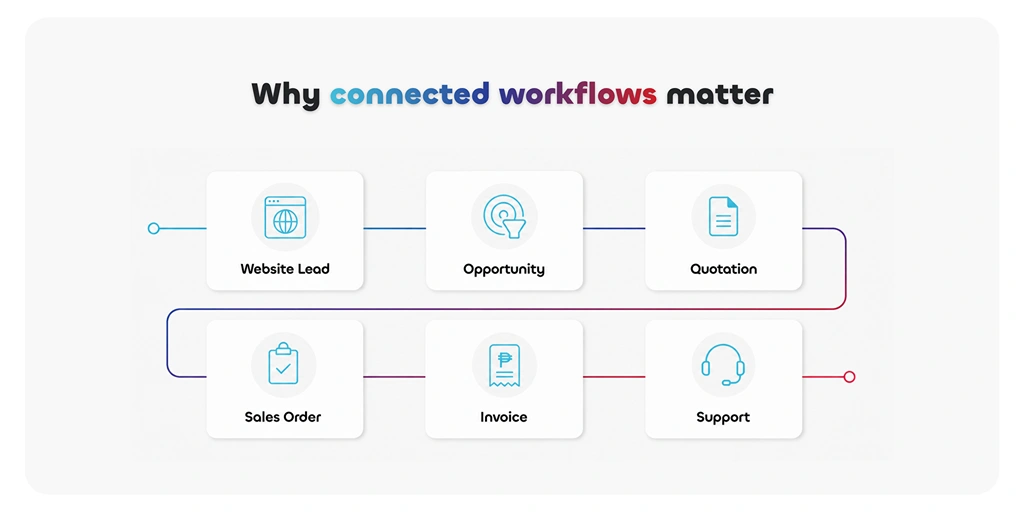
Connected workflows matter because a customer relationship rarely stays inside the CRM. Odoo lets a lead flow from website capture to opportunity, quotation, sales order, invoice, and support ticket within one integrated suite. Zoho CRM connects to 50+ Zoho apps, but Odoo's CRM sits natively inside a full business operating system.
This is where Odoo separates itself from many CRM-only platforms. Zoho has its own ecosystem of business apps, and Zoho CRM can connect with other Zoho tools useful for teams already working inside the Zoho environment.
Odoo's advantage is the way CRM sits inside a fully integrated business application suite. A business can connect CRM to quotations and sales orders, website lead capture, email campaigns, helpdesk tickets, invoices, accounting, inventory, and more. For example, a sales team can track an opportunity in Odoo CRM, create a quotation through Odoo Sales, turn it into a sales order, and continue into invoicing a smoother handoff from sales conversations to actual business transactions.
Reporting and Visibility: What Can Each Platform Show You?
Zoho CRM provides reporting and forecasting, with richer analytics and dashboards on higher editions. Odoo CRM supports sales reports, revenue forecasts, and custom dashboards, and because it connects to other Odoo apps, reporting can extend beyond the pipeline to show how leads become quotations, orders, invoices, and support cases.
Zoho CRM provides reporting and forecasting features, with more advanced analytics and dashboard options available in higher editions. Odoo CRM also supports sales reporting, revenue forecasts, team performance analysis, and custom dashboards. Because Odoo can connect CRM with other business apps, reporting can go beyond pipeline activity teams can build visibility around how leads become quotations, orders, invoices, and customer support cases. This matters for businesses that want to understand how sales activity connects with revenue, operations, and customer experience.
Which CRM Is Easier to Set Up and Use?
Zoho CRM is often quicker to adopt for sales teams thanks to its intuitive, sales-focused interface, though advanced workflows still need configuration. Odoo CRM works best when its pipeline stages, lead sources, activities, roles, and connected apps are structured around your real sales process, which is where an implementation partner adds the most value.
Zoho CRM can be a good option for teams that want a dedicated CRM with a broad feature set. However, as businesses move into more advanced workflows, careful configuration is still needed to make sure the system matches how the team actually sells.
Odoo CRM also works best when it is set up properly. The pipeline stages, lead sources, follow-up activities, user roles, reports, and connected apps should reflect the business process. That is where Kpability helps. A CRM should not simply be activated; it should be structured around the team's real sales workflow. Kpability helps businesses set up Odoo CRM so teams can manage leads, track opportunities, follow up consistently, and see sales performance more clearly.
Which CRM Should Growing Businesses Choose?
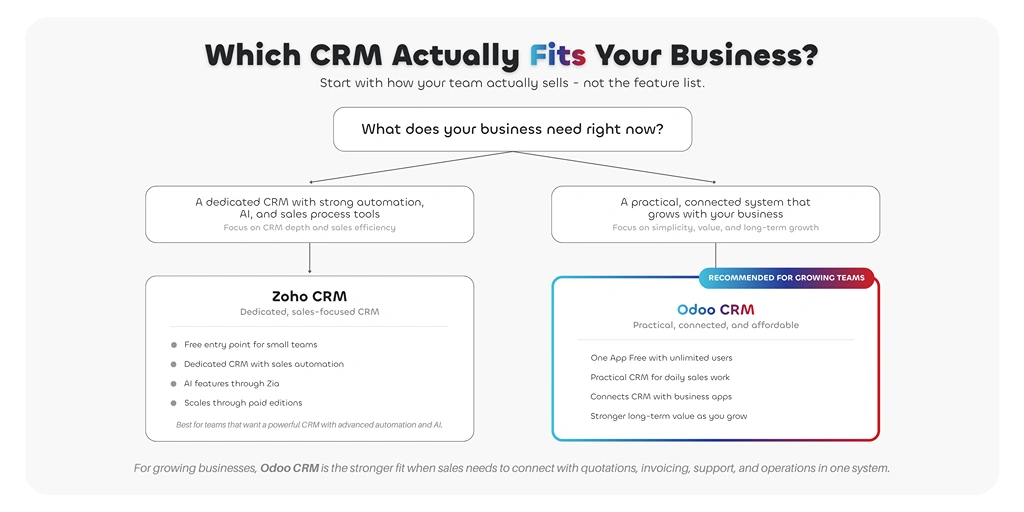
Choose Zoho CRM if you want a dedicated, sales-focused CRM with a free entry point, strong automation, and AI. Choose Odoo CRM if you want an affordable, connected system that grows beyond CRM into sales, invoicing, accounting, and support. For long-term value and fewer disconnected tools, Odoo is the stronger fit.
Zoho CRM is a strong option for teams that want a dedicated CRM with a free entry point, sales automation, AI features, and multiple paid editions. It may work well for businesses focused mainly on CRM and sales-process tools.
Odoo CRM is the better fit for businesses that want a practical, affordable, and connected system that can grow beyond CRM. It gives teams the tools to manage leads, opportunities, activities, quotations, forecasts, and reporting, while also allowing the business to expand into other connected apps. For companies that want long-term value, fewer disconnected tools, and a clearer path from sales activity to business operations, Odoo is a strong and efficient choice.
Frequently Asked Questions (FAQ)
The first four questions below are taken from Google's "People Also Ask" for this topic. (PAA) marks each one.
What is the difference between Odoo and Zoho?
The core difference is scope. Zoho CRM is a dedicated, sales-focused CRM within Zoho's ecosystem of 50+ separate cloud apps. Odoo CRM is one app inside a fully integrated ERP-style suite, so CRM connects natively to sales, invoicing, accounting, inventory, and support. Zoho is simpler to start with; Odoo goes deeper across your whole operation.
Is Odoo CRM free?
Partly. Odoo offers a One App Free plan that gives you a single app, such as CRM, with unlimited users at no license cost, and a free, self-hosted open-source Community Edition. To use CRM alongside other apps like Sales or Accounting, you move to a paid plan (Standard, around $31 per user/month in the US). So Odoo CRM can be free on its own, but not as part of the full connected suite.
Which is easier to use, Odoo or Zoho?
For a sales team, Zoho CRM is generally easier to use out of the box thanks to its clean, intuitive, sales-focused interface and quick setup. Odoo CRM is very capable but has an ERP-style interface and delivers its best experience once it is configured around your actual sales process, which is why many teams use an implementation partner.
Is Odoo cheaper than Zoho?
It depends on how you use each platform. Zoho CRM is usually cheaper to start for a small, CRM-only team because of its free tier and low entry price (~$14/user/month). Odoo can be more cost-efficient overall for teams that need CRM plus other functions sales, invoicing, accounting, inventory since one Odoo subscription covers all apps rather than paying separately for each. Regional pricing also affects the comparison.
Does Odoo CRM have AI features?
Yes. Odoo CRM includes AI lead scoring, which ranks leads by their likelihood to convert so sales teams can prioritize the best opportunities. Zoho CRM offers AI through its Zia assistant, including predictions, recommendations, and anomaly detection, which is available on its higher Enterprise and Ultimate editions.
Can Odoo CRM connect to invoicing and accounting?
Yes. Because Odoo CRM is part of Odoo's connected suite, a lead can flow from CRM to a quotation, sales order, invoice, and accounting entry within the same system. This is one of Odoo's main advantages over CRM-only platforms and removes the need for separate integrations.
How does Kpability help with Odoo CRM?
Kpability helps businesses set up and structure Odoo CRM around their real sales workflow, configuring pipeline stages, lead sources, follow-up activities, user roles, reports, and connected apps. This ensures teams can manage leads, track opportunities, follow up consistently, and see sales performance clearly from day one.
The Bottom Line
Zoho CRM is a capable platform, especially for businesses looking for a dedicated CRM with sales automation and multiple plan options. But for growing businesses that want a more cost-efficient system that can support sales and connect with the rest of the business, Odoo CRM offers stronger long-term value. Odoo helps teams manage leads, track opportunities, schedule follow-ups, create quotations, view forecasts, and connect CRM with other business workflows, giving companies a practical way to improve sales visibility without making the system more expensive or complicated than it needs to be.

Related posts

Beyond Traffic: Key Takeaways on AI Analytics, Content Experiences, and Digital Conversions
Beyond Traffic was an event hosted by Kpability and Magnolia on September 24, 2026, at Fairmont Makati, bringing…

Zoho CRM vs Odoo CRM: Which Is Better for Growing Businesses in 2026?
If you are comparing Zoho CRM and Odoo CRM, the short answer is this: Zoho CRM is the…

Odoo vs HubSpot: Which CRM Gives Growing Businesses More Value?
Odoo CRM is the better value for most growing businesses because its pricing stays predictable as teams scale…