
Odoo vs HubSpot: Which CRM Gives Growing Businesses More Value?
Odoo CRM is the better value for most growing businesses because its pricing stays predictable as teams scale and it connects natively to sales, invoicing, helpdesk, and other operations. HubSpot CRM is the stronger pick for teams that prioritize inbound marketing, email engagement, and a fast, no-setup start. The right choice depends on whether you need a connected business system (Odoo) or a marketing-led sales platform (HubSpot).
Choosing between Odoo CRM and HubSpot CRM is not just about comparing two software platforms. It is about understanding how your business sells, how your team follows up, how much visibility you need, and how far you want your CRM to support the rest of your operations.
HubSpot is a well-known CRM platform, especially for businesses that want a user-friendly system for sales, marketing, and customer engagement. It is popular for its clean interface, free CRM entry point, and strong inbound marketing ecosystem.
Odoo CRM, on the other hand, takes a broader approach. It gives businesses a practical CRM system for managing leads, opportunities, follow-ups, quotations, and reporting, while also connecting with other Odoo apps such as Sales, Website, Email Marketing, Helpdesk, Invoicing, and more.
Both platforms can help businesses manage customer relationships better. But for growing teams that want efficiency, affordability, and long-term flexibility, Odoo CRM offers a strong advantage.
What Is HubSpot CRM?
HubSpot CRM is designed to help businesses organize customer data, manage contacts, track deals, and support sales and marketing activities. Its free CRM is one of its most recognizable strengths, making it attractive for startups and small teams that want to move away from spreadsheets.
HubSpot also offers Sales Hub, Marketing Hub, Service Hub, Content Hub, Data Hub, and other tools that extend the CRM experience. This makes HubSpot a strong option for businesses that are heavily focused on inbound marketing, lead nurturing, and sales engagement.
The trade-off is that as a business grows, more advanced features may depend on the right Hub, subscription tier, seat type, contact limits, and paid add-ons. For some teams, this can make the pricing structure harder to evaluate over time.
What Is Odoo CRM?
Odoo CRM is built around practical sales management. It helps teams track leads, manage opportunities, schedule activities, create quotations, view forecasts, and keep the sales pipeline organized. It is especially useful for businesses that want a CRM that connects not only with marketing and sales, but also with the operational side of the business.
The bigger difference is that Odoo is not just a CRM. It is a suite of connected business applications. This means a company can start with CRM and expand into other apps as its needs grow.
A business can connect its CRM to sales orders, website forms, email campaigns, helpdesk tickets, invoices, and other workflows without moving into a completely separate system.
For companies that want their CRM to become part of a bigger business management setup, this is where Odoo becomes especially practical.
Odoo vs HubSpot: Side-by-Side Comparison
A quick, scannable breakdown of how the two platforms compare across the factors that matter most to growing businesses.
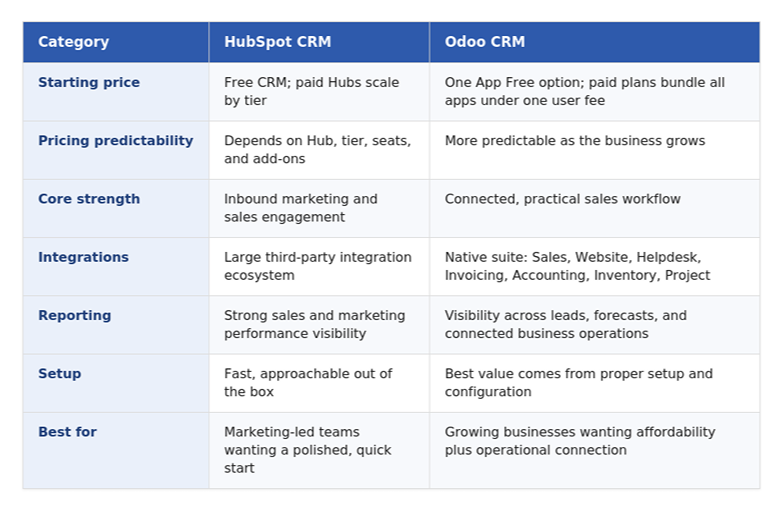
How Does Pricing Compare Between Odoo and HubSpot?
HubSpot's free CRM is a strong starting point. It gives small teams access to basic CRM tools without an upfront subscription. For early-stage businesses, that can be very useful.
However, the real comparison starts when a business needs more than basic CRM. As teams grow, they may need stronger automation, reporting, sales productivity tools, marketing features, service tools, or additional contacts.
At that point, costs can depend on which Hub is needed, which plan tier applies, how many seats are required, and which features are included.
Odoo's pricing structure is easier to understand for many growing businesses. Odoo offers a One App Free option for businesses that only need one app, and its paid plans include all apps under a single user-based fee.
That makes it easier to plan for growth because teams are not forced to keep adding separate product hubs just to connect related workflows.
This is one of Odoo's biggest advantages: affordability is not only about the starting price. It is about how predictable the system remains as the business grows.
Which CRM Has Better Features: Odoo or HubSpot?
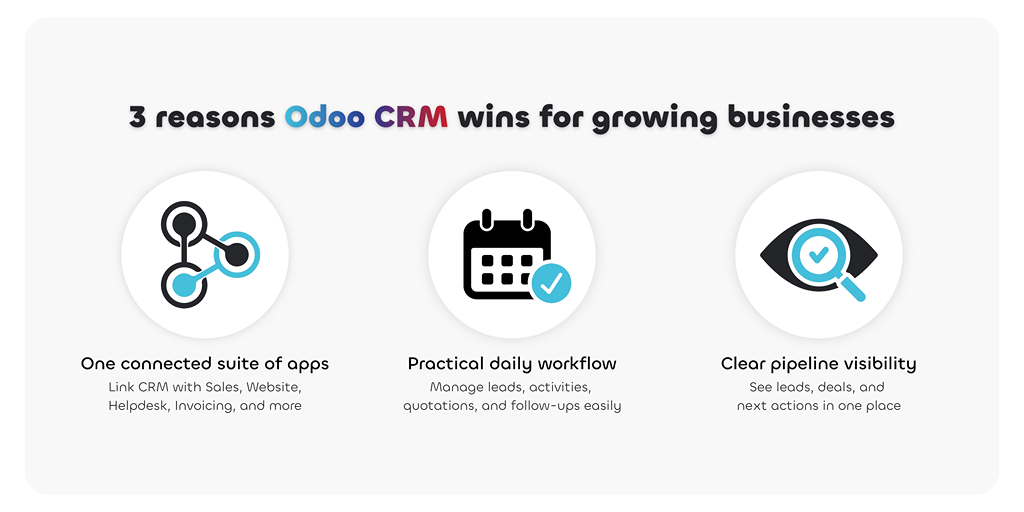
Both Odoo and HubSpot support core CRM needs such as contact management, deal tracking, pipeline management, and sales activity visibility.
- HubSpot: polished and user-friendly, especially for teams relying on email tracking, meetings, sales engagement, and marketing campaigns.
- Odoo: focused on day-to-day sales workflow — managing leads, dragging and dropping opportunities across pipeline stages, scheduling next actions, sending quotations, and reviewing forecasts.
This makes it a practical fit for businesses that want a CRM that is clear, structured, and easy to connect with actual sales operations.
For many teams, the best CRM is not the one with the longest list of features. It is the one that helps salespeople know what to do next. Odoo does that well.
How Do Odoo and HubSpot Compare on Integrations?
HubSpot has a strong ecosystem of integrations and works well with many third-party tools. This is helpful for businesses that already use separate platforms for sales, marketing, service, websites, payments, and reporting.
Odoo's advantage is different. Instead of relying mainly on connecting separate tools, Odoo gives businesses a connected suite of apps that can work together natively. CRM can connect with Sales, Email Marketing, Website, Helpdesk, Invoicing, Accounting, Inventory, Project, and other business applications.
This matters because customer relationships do not stop at the sales pipeline. A lead may become a quotation, then a confirmed order, then an invoice, then a support request, then a repeat customer. With Odoo, more of that journey can stay within one connected environment.
For businesses that want fewer disconnected tools and clearer operational visibility, Odoo has a stronger long-term value proposition.
Which CRM Offers Better Reporting and Visibility?
A CRM should help managers see what is happening across the sales process. Both HubSpot and Odoo offer reporting capabilities, but the difference comes down to the kind of visibility a business needs.
HubSpot is strong for sales and marketing performance visibility, especially for teams focused on lead generation, campaigns, email engagement, and pipeline activity.
Odoo CRM gives visibility into leads, opportunities, forecasts, sales teams, activities, and connected business workflows. Because Odoo can connect CRM with other business apps, reporting can go beyond marketing and sales activity. It can support a clearer view of how customer opportunities move into quotations, orders, billing, and service.
For businesses that want CRM reporting to connect with actual business operations, Odoo is a practical choice.
Which CRM Is Easier to Set Up and Use?
HubSpot is known for being approachable. Many teams like it because it is easy to start using, especially for contact management and simple pipeline tracking.
Odoo is also designed to be usable, but its real value comes from proper setup. To get the most out of Odoo CRM, businesses should define their pipeline stages, lead sources, follow-up rules, activity types, reports, and team responsibilities. Once these are structured well, Odoo can support a clear and efficient sales process.
This is where implementation support matters. A CRM should not just be installed. It should be aligned with the way the business actually sells.
Kpability helps businesses set up Odoo CRM in a way that supports real sales work: lead tracking, pipeline management, follow-ups, reporting, and connected workflows.
Which CRM Is Better for Growing Businesses?
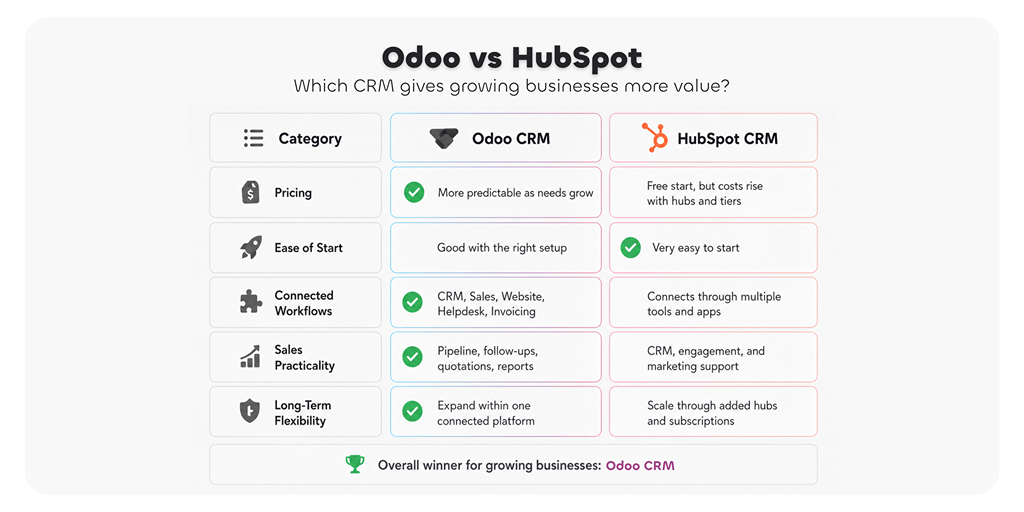
HubSpot is a strong CRM platform, especially for teams that prioritize inbound marketing, email engagement, and a polished sales and marketing experience. It is a good option for businesses that want to start quickly and are comfortable scaling through HubSpot's product tiers.
Odoo CRM is the better fit for businesses that want a more cost-efficient and operationally connected system. It gives teams the CRM tools they need for lead management, opportunity tracking, follow-ups, quotations, forecasting, and reporting, while also giving the business room to expand into other connected apps.
For growing businesses that want more value from every software investment, Odoo offers a practical balance of affordability, usability, and long-term flexibility.
Frequently Asked Questions
Is Odoo CRM cheaper than HubSpot?
For growing teams, often yes over time. HubSpot's free CRM is cheapest at the very start, but costs can rise as a business adds Hubs, tiers, seats, and contacts. Odoo offers a One App Free option and bundles all apps under a single user-based fee, which tends to stay more predictable as the business scales.
What is the main difference between Odoo CRM and HubSpot CRM?
HubSpot is a marketing-led CRM built around inbound marketing and sales engagement tools. Odoo is part of a connected suite of business apps, so its CRM links natively to sales, invoicing, helpdesk, accounting, and more.
Which CRM is easier to set up, Odoo or HubSpot?
HubSpot is generally faster to start using out of the box. Odoo can match that ease of use, but its full value depends on proper setup of pipeline stages, lead sources, and follow-up rules, which is why implementation support is often recommended.
Is Odoo CRM good for small businesses?
Yes. Odoo's One App Free plan lets small teams start with CRM alone, and the ability to add connected apps like Sales, Website, and Invoicing later makes it easy to grow without switching systems.
Does Odoo CRM integrate with other business tools?
Odoo CRM connects natively with other Odoo apps, including Sales, Website, Email Marketing, Helpdesk, Invoicing, Accounting, Inventory, and Project. This keeps the full customer journey, from lead to invoice, inside one connected system.
Book a free demo with Kpability and see how Odoo CRM can support a more efficient, affordable, and connected way to manage your sales process.
The Bottom Line
HubSpot is a strong CRM. But for many businesses, especially those looking for an efficient and affordable CRM that can grow into a broader business system, Odoo CRM is the more practical choice.
Odoo helps teams manage leads, track opportunities, schedule activities, send quotations, and view sales performance more clearly. More importantly, it can connect CRM with the rest of the business, from website lead capture to sales orders, invoicing, customer support, and reporting.
A CRM should not make growth more expensive or more complicated than it needs to be. With the right setup, Odoo CRM gives businesses a smarter way to manage sales, improve visibility, and build a system that can grow with them.
Book a free demo with Kpability and see how Odoo CRM can support a more efficient, affordable, and connected way to manage your sales process.

Related posts

Beyond Traffic: Key Takeaways on AI Analytics, Content Experiences, and Digital Conversions
Beyond Traffic was an event hosted by Kpability and Magnolia on September 24, 2026, at Fairmont Makati, bringing…

Zoho CRM vs Odoo CRM: Which Is Better for Growing Businesses in 2026?
If you are comparing Zoho CRM and Odoo CRM, the short answer is this: Zoho CRM is the…

Odoo vs HubSpot: Which CRM Gives Growing Businesses More Value?
Odoo CRM is the better value for most growing businesses because its pricing stays predictable as teams scale…