Knect, Powered by Odoo: Why Customer Conversations Break Across Channels
Customer conversations rarely happen in one place anymore. A customer may discover your business on social media, ask a question through Messenger, submit a form on your website, receive a follow-up by email, and later send another inquiry through Viber or WhatsApp.
From the customer’s point of view, this is one continuous conversation. From the team’s perspective, it often becomes five separate threads. That is where the breakdown begins.
For many SMEs and mid-market businesses, the issue is not a lack of effort. Teams are responding, checking inboxes, updating spreadsheets, sending reminders, and trying to keep leads moving.
The problem is that the work happens across disconnected tools. When messages, customer history, lead status, and follow-up tasks are scattered, conversations become harder to manage than they should be.
This is exactly the gap that Knect, powered by Odoo, is built to address. Knect helps businesses bring customer communication, lead handling, omnichannel engagement, and reporting into one connected flow, so teams can stop chasing context and start moving conversations forward.
Why Conversations Break Across Channels

Customer conversations break when the channel becomes more visible than the customer. A Facebook message is treated as a social media task. A website form becomes a sales lead. An email reply sits in one person’s inbox. A Viber message becomes a separate follow-up.
Each interaction may be handled, but the bigger customer journey is not always clear. This creates several common problems.
First, context gets lost. A customer who already asked about pricing may need to explain the same concern again when another team member replies.
A lead who submitted a form may not be linked to a previous chat. A complaint may be resolved in one channel, while another team member is still following up somewhere else.
Second, ownership becomes unclear. When an inquiry comes in, who should respond? Who checks if it was already handled? Who knows the next step? Without clear visibility, teams either duplicate work or assume someone else has it covered.
Third, reporting becomes incomplete. Platform dashboards may show clicks, messages, or engagement, but they do not always show what happened after the conversation started.
Did the inquiry become a qualified lead? Was there a follow-up? Did it move into the pipeline? Did the team respond fast enough? When these answers are unclear, growth becomes harder to manage.
What It Costs Your Team
Disconnected conversations do not just affect customer experience. They quietly cost the team time, focus, and opportunities.
The first cost is lost productivity. Team members spend too much time switching between tools, checking multiple inboxes, and manually updating records. A simple follow-up becomes a process of searching, copying, confirming, and rechecking.
The second cost is a slower response time. When inquiries are scattered, urgent messages are easier to miss. This matters because customers often reach out when their interest is highest. A delayed response can turn a warm inquiry into a cold lead.
The third cost is inconsistent communication. If customer history is not visible, replies depend on whoever sees the message first. One person may have the full context. Another may only see the latest message. This can make the business feel less coordinated, even when the team is working hard behind the scenes.
The fourth cost is weak accountability. Without a central view of conversations, it becomes difficult to know which leads are active, which ones need follow-up, and which ones have already gone cold.
The fifth cost is unclear ROI. Marketing may generate attention, but if the handoff from campaign to conversation to lead management is not connected, it becomes harder to know which efforts are actually creating business value.
In short, the cost is not always obvious at first. It shows up as missed inquiries, delayed replies, repeated questions, unclear ownership, and reporting that does not tell the full story.
Why More Channels Do Not Automatically Mean Better Communication
Omnichannel communication is not just about being present on every channel. It is about making those channels work together.
A business can be active on email, SMS, website, Facebook, Messenger, Viber, and WhatsApp, but still deliver a fragmented experience if each channel operates separately.
More channels can even create more confusion if the team does not have one connected system behind them. This is why the real goal is not simply channel expansion. The goal is conversation continuity.
Conversation continuity means the team can see who the customer is, where the inquiry came from, what was already discussed, who is handling it, and what should happen next.
It means the conversation does not restart every time the customer changes channels. It also means marketing, sales, and service teams can work from the same context. That is where a customer communication platform becomes important.
How Knect Helps Reconnect the Customer Journey
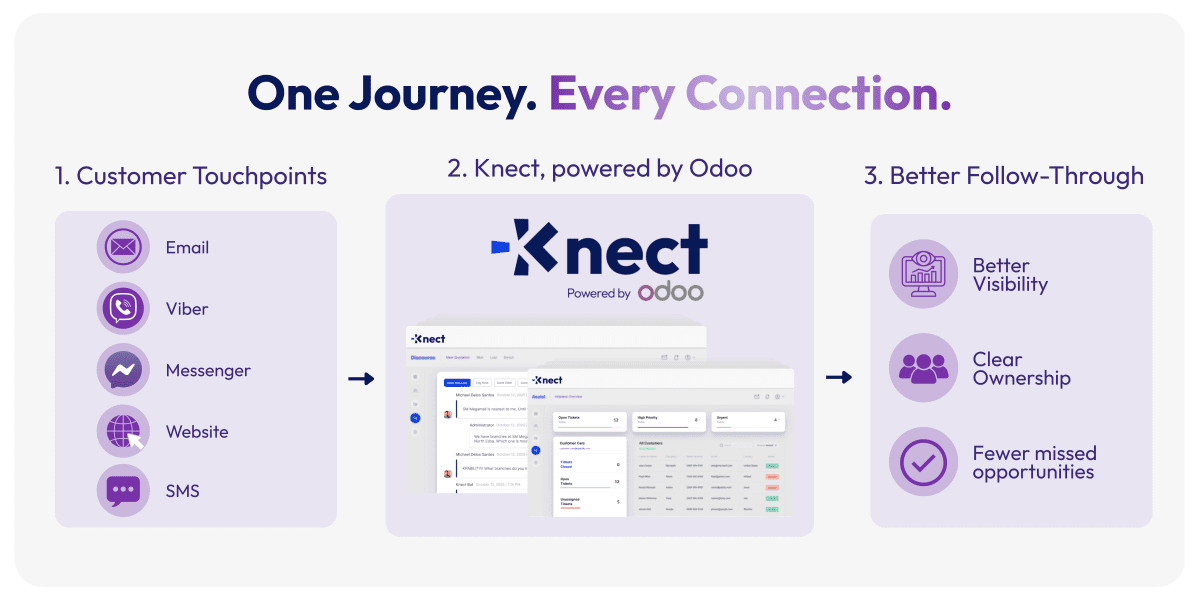
Knect, powered by Odoo, is designed to support both one-to-many marketing and one-to-one conversations.
Instead of treating outbound campaigns and inbound inquiries as separate activities, Knect helps bring them into one connected workflow. This matters because modern customer engagement does not stop after a campaign is sent. In many cases, the real opportunity starts when the customer responds.
With Knect, businesses can capture leads from multiple entry points, manage real-time conversations, track customer history, and support follow-ups through a centralized CRM foundation. This gives teams a clearer view of the customer journey, from first inquiry to next action.
For example, a customer may respond to a campaign through Viber, ask a product question through Messenger, and later submit a form on the website.
Instead of treating those interactions as separate records, Knect helps teams connect the activity to the customer profile and lead flow. That means better visibility, clearer ownership, and fewer missed opportunities.
Powered by Odoo: Why the Foundation Matters
Knect is powered by Odoo, a platform known for bringing business applications into one connected system. This foundation matters because customer communication does not exist in isolation. It connects to CRM, marketing, sales, service, reporting, and operational workflows.
When customer conversations are tied to a stronger business system, teams get more than a message inbox. They get structure.
A connected CRM helps teams track leads and customer activity. Marketing tools help support campaigns and follow-ups. Conversation history helps teams respond with context. Reporting helps leaders understand what is working and where the process needs improvement.
For growing businesses, this is especially important. Many teams do not need more complexity. They need a practical system that helps them organize communication, reduce manual work, and create a more consistent customer experience.
What a Connected Conversation Flow Looks Like
A stronger customer communication process usually follows a clearer flow.
First, the customer enters through any available channel. This may be social media, website, SMS, email, Viber, WhatsApp, or another messaging touchpoint.
Second, the inquiry is captured and connected to a customer or lead profile. The team can see where the inquiry came from and what information is already available.
Third, the right person or team handles the conversation. This reduces confusion around ownership and helps make sure the inquiry does not sit unanswered.
Fourth, follow-ups are tracked. The team knows what has been done, what needs to happen next, and where the lead stands.
Fifth, performance becomes measurable. Leaders can review lead attribution, campaign performance, channel performance, customer response performance, and pipeline movement.
This is the difference between having many conversations and having a system for managing them.
Why This Matters for SMEs and Mid-Market Teams
For SMEs and mid-market businesses, broken conversations are especially costly because teams are often lean. One person may handle marketing, sales coordination, customer inquiries, and reporting. When tools are disconnected, the workload becomes heavier than it needs to be.
Knect helps reduce that pressure by bringing the essentials together: lead capture, customer conversations, omnichannel engagement, CRM visibility, and analytics.
Instead of forcing teams to manage growth through scattered tools and manual tracking, Knect gives them a more organized way to work. The result is not just faster replies. It provides better control over the full customer journey.
The Bottom Line
Customer conversations break when channels do not work together. A business may be present across multiple platforms, but if customer context, ownership, follow-ups, and reporting are disconnected, the team still works with gaps.
Those gaps cost time, slow down responses, weaken visibility, and make customer experience harder to manage.
Knect, powered by Odoo, helps businesses move from scattered communication to connected customer conversations. It gives teams a clearer way to capture inquiries, manage engagement, track follow-ups, and understand performance across channels.
In modern customer communication, the goal is not just to answer messages. The goal is to keep every conversation moving. Ready to connect your customer conversations across channels? Book your FREE Knect demo with Kpability today.

Related posts
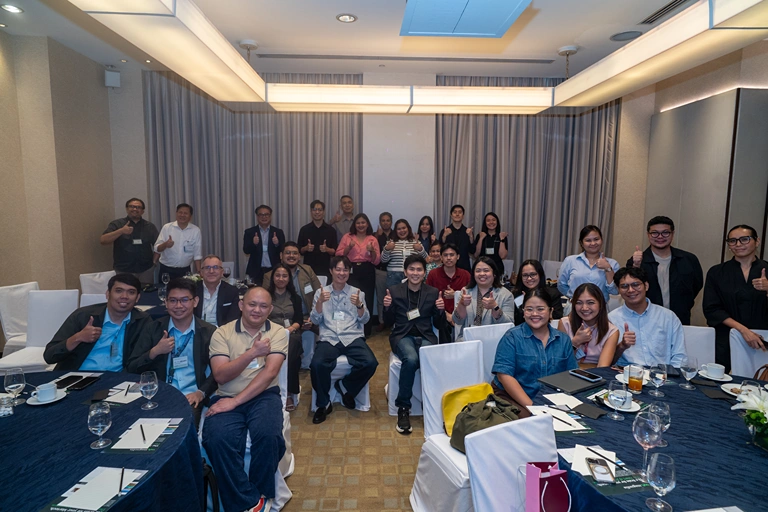
Beyond Traffic: Key Takeaways on AI Analytics, Content Experiences, and Digital Conversions
Beyond Traffic was an event hosted by Kpability and Magnolia on September 24, 2026, at Fairmont Makati, bringing…

Zoho CRM vs Odoo CRM: Which Is Better for Growing Businesses in 2026?
If you are comparing Zoho CRM and Odoo CRM, the short answer is this: Zoho CRM is the…

Odoo vs HubSpot: Which CRM Gives Growing Businesses More Value?
Odoo CRM is the better value for most growing businesses because its pricing stays predictable as teams scale…