The Digital Marketing Landscape in the Philippines: Trends, Strategies, and Future Outlook
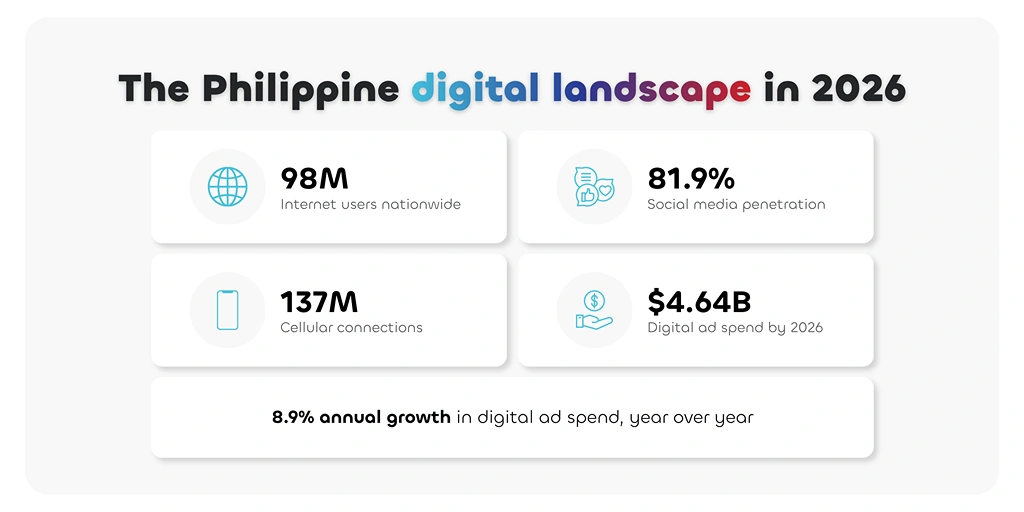
The digital marketing landscape in the Philippines is essential for every business in the Philippines in 2026 because the country has 98 million internet users (83.8% penetration), 95.8 million social media identities, and a digital ad market growing at 8.9% annually — businesses present online but without a structured strategy are losing ground to those that have one.
The Philippines is one of the most digitally active countries in the world, and in 2026, that distinction carries real commercial weight. As of late 2025, the country had 137 million cellular connections, surpassing a total population of 117 million, with 89% of those connections broadband-capable. There were 98.0 million internet users in the Philippines at the end of 2025, with online penetration standing at 83.8%.
The Philippines was home to 95.8 million social media user identities in 2026, equating to 81.9% of the total population. For businesses, these numbers represent one of the most concentrated and accessible digital audiences in Southeast Asia. The digital ad spend market in the Philippines is expected to grow by 8.9% annually, reaching USD 4.64 billion by 2026.
Yet having access to a large digital audience is not the same as having a digital marketing strategy in the Philippines that captures it. The gap between Philippine businesses that are present online and those that are performing online is significant. This article is built to close that gap by explaining the fundamentals, mapping the landscape by channel and industry, and providing the framework to build or revamp your digital marketing strategy in the Philippines for 2026.
Digital Marketing Fundamentals: What Every Business Needs to Understand
Digital marketing fundamentals are the six core pillars every Philippine business must understand: SEO, content marketing, paid advertising, social media marketing, email and messaging marketing, and analytics — together they define every online touchpoint a customer has with your brand, from first Google search to purchase.
Before exploring channels and industry applications, it helps to ground the conversation in digital marketing fundamentals, because misunderstanding these basics is the root cause of most underperforming campaigns.
Digital marketing is the use of internet-based channels and technologies to promote products, services, or brands to target audiences. It encompasses every touchpoint a customer has with a business online, from the first Google search through social media discovery, email engagement, paid ads, and eventual purchase.
What separates digital marketing from traditional marketing is measurability, targeting precision, and cost efficiency. Every campaign element can be tracked, and every peso spent can be tied to a measurable outcome.
The core pillars of digital marketing fundamentals include:
- Search Engine Optimization (SEO) — the practice of optimizing your website and content so it ranks prominently in search engine results for relevant queries. Only 0.63% of Google searches result in a click on page two, making first-page visibility a commercial necessity.
- Content Marketing — creating and distributing valuable, relevant content that attracts, educates, and converts your target audience. Content builds trust, improves SEO, and nurtures leads through the buying journey.
- Paid Advertising (SEM/PPC) — using paid placements on search engines, social platforms, and display networks to reach targeted audiences immediately. Unlike SEO, paid channels deliver traffic from day one but require ongoing investment.
- Social Media Marketing — building brand presence, engaging audiences, and driving traffic or conversions through organic and paid activity on social platforms. In the Philippines, this is the primary discovery channel for most consumer brands.
- Email and Messaging Marketing — direct communication with prospects and customers through email, SMS, Viber, and other messaging channels. These are the highest-ROI channels for retention, nurturing, and repeat purchases.
- Analytics and Data — measuring campaign performance through tools like Google Analytics, Meta Pixel, and CRM dashboards to understand what is working and improve continuously.
Understanding these digital marketing fundamentals is the prerequisite for everything else in this guide.
Marketing Strategy Importance: Why a Strategy Comes Before Tactics
Marketing strategy importance means that without a defined audience, objective, and measurement framework, every campaign operates in isolation — Philippine businesses that skip strategy and jump to tactics consistently generate activity without building on learning or understanding what is driving actual business outcomes.
One of the most common and costly mistakes Philippine businesses make is skipping the strategy and jumping straight to tactics. They open a Facebook page, run a few boosted posts, and wonder why they are not growing. The problem is not the tactic. It is the absence of a clear strategy.
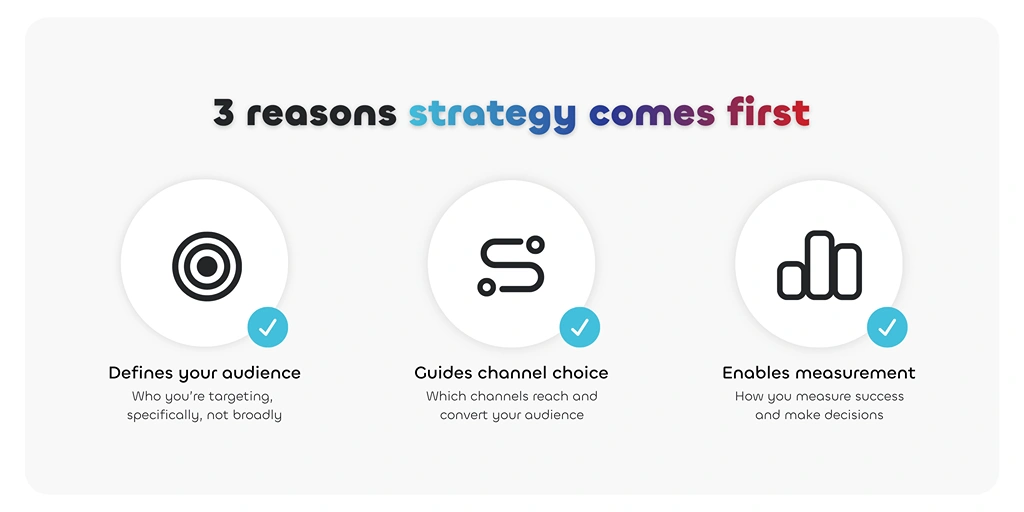
Marketing strategy importance refers to the fundamental role that a well-defined strategy plays in determining whether your marketing activities add up to business results or just activity. A strategy defines:
- Who your target audience is, specifically, not broadly
- What problem you solve for them and why they should choose you over competitors
- Which channels are most likely to reach and convert your audience
- How your messages and campaigns connect to business goals like revenue, leads, or retention
- How you will measure success and make decisions based on data
Without a strategy, businesses end up scattered across every channel, spending money without understanding what is working, and unable to replicate their wins. With a clear strategy, every campaign, post, ad, and email serves a defined purpose within a larger plan.
In 2026, the marketing strategy importance conversation in the Philippines has evolved beyond basic awareness. Hyper-personalization has become one of the most important digital marketing shifts in the country, with Filipinos expecting product recommendations tailored to their browsing activity, past purchases, and the type of content they consume. A strategy that does not account for personalization at scale is already falling short of customer expectations.
The Digital Marketing Landscape in the Philippines: 2026 State of Play

Internet and Device Usage
Internet speeds have improved notably, with median mobile download speed reaching 59.6 Mbps, up 77% year-on-year, while fixed broadband speeds averaged 105.2 Mbps, an 11.4% increase. This infrastructure improvement directly expands what is possible for video marketing, live streaming, interactive content, and mobile commerce in the Philippine market.
The Philippine population skews young, with a median age of 26.1 years and almost half the population under 26. This demographic reality shapes what channels work, what content resonates, and what purchase behaviors dominate in the market.
Advertising Spend
The Philippines digital advertising market reached USD 2.1 billion in 2025 and is projected to reach USD 5.4 billion by 2034, exhibiting a CAGR of 11.22% during 2026 to 2034. Within the advertising market, 65% of total ad spending is projected to come from digital advertising by 2029, with 78% of revenue anticipated to be generated through programmatic advertising by 2029.
This shift in digital share represents a paradigm shift in the local industry. Brands are prioritizing signal-based experiences with highly targeted digital campaigns that follow the consumer from discovery to checkout.
Digital Marketing Trends in the Philippines for 2026
Staying current with digital marketing trends in the Philippines is not optional when customer behavior and platform algorithms evolve this quickly. Here are the defining trends shaping the landscape in 2026:
1. AI-Powered Personalization at Scale
AI-powered marketing tools have become part of the everyday workflow for Filipino entrepreneurs. From content creation to customer service, AI handles audience segmentation, content generation, predictive lead scoring, and send-time optimization. This makes sophisticated personalization accessible to SMEs that previously could not afford dedicated analytics teams.
2. Short-Form Video Dominance
Short-form video remains the king of digital content in 2026, especially in the Philippines, where TikTok, Facebook Reels, and YouTube Shorts dominate daily screen time. Filipinos respond strongly to fast, entertaining, and relatable videos that teach them something new or convince them to try a trending product.
3. Social Commerce Integration
The Philippines social commerce market reached USD 28.4 billion in 2025, highlighting opportunities for advertising strategies that integrate content, commerce, and community engagement. TikTok Shop, Facebook Shops, and Instagram Shopping are now full purchase channels, not just awareness platforms.
4. Influencer-Led Marketing
Influencer advertising recorded the strongest year-on-year growth across all digital ad categories in the Philippines, with estimated annual spend reaching USD 125 million. Micro-influencers with niche audiences and strong engagement rates are driving the most cost-effective results for Philippine brands in 2026.
5. Omnichannel Customer Journeys
Filipino consumers move seamlessly between online and offline channels, discovering a product on TikTok, researching it on Google, and buying it in-store, or vice versa. In 2026, omnichannel marketing ensures consistency across platforms. Messaging, pricing, and branding must align whether customers shop on Shopee, Lazada, social media, or physical locations.
6. Voice Search and Conversational Queries
Voice search continues to grow in the Philippines as smartphones, smart assistants, and hands-free browsing become more common. By 2026, more Filipinos are speaking their searches instead of typing them, often using Taglish or local expressions. Brands that optimize content for natural language and question-based queries gain a structural advantage in organic search.
7. Zero-Party and First-Party Data Strategies
With third-party cookies largely deprecated, Philippine marketers are shifting to direct data collection through preference centers, quizzes, and loyalty programs. Brands that own their customer data are significantly less exposed to platform algorithm changes and privacy regulation updates.
8. Community-Led Engagement
With 70% of consumers buying based on influencer trust and 62% using TikTok or Facebook for brand research, a brand's social presence is its reputation. Brands are building owned communities on Facebook Groups, Viber, and Discord as organic reach on public feeds continues to decline.
Online Advertising Types: The Complete Breakdown for Philippine Businesses
Understanding online advertising types is essential before allocating budget. The Philippine digital advertising market segments into several distinct categories, each with different strengths, cost structures, and use cases.
Search Engine Advertising in the Philippines
Search engine advertising in the Philippines refers to paid placements on Google Search, which holds over 93% of the Philippine search market, that appear when users search for specific keywords. These ads appear above and below organic results and are charged only when a user clicks.
Search advertising is intent-driven: users who click are actively looking for what you sell, making it one of the highest-converting ad formats available. It is particularly effective for financial services, insurance, automotive, real estate, and B2B services, where customers research extensively before purchasing.
PPC Advertising in the Philippines
PPC advertising in the Philippines covers the broader category of pay-per-click campaigns across both search engines and social platforms. Beyond Google Ads, PPC includes:
- Google Search Ads: text-based ads appearing in search results for targeted keywords
- Google Display Network: visual banner ads appearing across millions of websites and apps
- YouTube Ads: pre-roll, mid-roll, and in-feed video ads on the Philippines' most-watched video platform
- Meta Ads (Facebook and Instagram): PPC campaigns on the platforms where Filipino consumers spend the most time
- TikTok Ads: in-feed video ads and branded content on the fastest-growing platform in the country
A well-structured PPC advertising in the Philippines strategy combines search intent with social awareness, using each platform for the stage of the customer journey where it performs best.
Display Advertising in the Philippines
Display advertising in the Philippines refers to visual ad formats including banner ads, rich media, and video ads placed across websites, apps, and content platforms. These include:
- Standard display banners: static or animated image ads placed through Google Display Network or local publisher networks
- Programmatic display: AI-automated ad buying that places display ads in real time based on audience targeting signals
- Native advertising: sponsored content that blends with editorial content on news sites and content platforms
- Video display ads: pre-roll and mid-roll ads on video streaming platforms
The Philippines advertising market is experiencing a rise in programmatic adoption, enhancing targeted and data-driven campaigns for businesses. Programmatic is the fastest-growing delivery method for display advertising in the Philippines, with 78% of digital revenue projected to flow through programmatic channels by 2029.
Digital advertising examples of display formats performing well in the Philippines in 2026 include:
- Animated product carousels on Facebook targeting payday window audiences
- YouTube pre-roll ads with a 5-second hook designed around Filipino cultural moments
- Native content ads on leading Philippine news sites for financial products and automotive
- Retargeting banner sequences showing previously viewed products to e-commerce browsers
Social Media Marketing in the Philippines
Social media marketing in the Philippines is the single largest and most actively used digital channel category for Philippine brands. Social media advertising's share of total digital ad spend grew by 4.9%, with estimated annual spend on social media advertising reaching USD 679 million.
Facebook remains the dominant platform with nearly 95.8 million users. Instagram and TikTok follow as the key channels for younger demographics, product discovery, and short-form video content. LinkedIn is growing rapidly for B2B, reaching 22.0 million members in the Philippines in late 2025, equivalent to 28.1% of the adult population.
Facebook Marketing Strategy in the Philippines
A Facebook marketing strategy for Philippine businesses in 2026 must account for the platform's dual role as both an organic community builder and a paid performance channel.
Organic Facebook approach:
- Build and maintain a Facebook Page with consistent brand voice and regular content
- Use Facebook Groups to build owned communities around brand values, loyalty programs, or shared interests
- Publish a mix of educational content, product features, behind-the-scenes content, and customer stories
- Leverage Facebook Reels for short-form video to reach non-followers
Paid Facebook approach:
- Run awareness campaigns using video ads targeted to defined demographic and interest audiences
- Use conversion campaigns with Meta Pixel to retarget website visitors and abandoned cart users
- Deploy catalog ads for e-commerce to dynamically show users products they have viewed
- Segment audiences using Custom Audiences from CRM data for personalized promotional campaigns
- Use the lookalike audience feature to find new customers who match your best existing buyers
For SME online advertising in the Philippines, Facebook remains the most accessible entry point. Even modest budgets of PHP 5,000 to PHP 20,000 per month can drive meaningful reach and leads when campaigns are well-structured and targeted. The key is moving beyond boosted posts toward properly structured campaign objectives such as Awareness, Traffic, Leads, and Conversions with audience targeting, creative testing, and performance tracking in place.
Lead generation in the Philippines is where digital marketing investment converts into business outcomes. All the reach, clicks, and impressions mean nothing if they do not ultimately produce qualified prospects who can become customers.
Effective lead generation in the Philippines in 2026 requires a multi-channel approach that matches the customer's preferred discovery and engagement behavior:
- Search-driven: SEO and Google Ads capture users who are actively searching for a solution. These are the highest-intent leads and typically convert at higher rates than social-sourced leads. For industries with high search volume such as insurance, banking, auto, real estate, and legal services, search is the foundation.
- Social-driven: Facebook Lead Ads, Instagram Lead Forms, and TikTok Lead Generation allow users to submit their contact information without leaving the platform. This reduces friction significantly and works well for high-awareness categories where consumers need education before committing.
- Content-driven: Long-form blog content, downloadable guides, webinars, and video explainers attract prospects at the research stage and capture leads through embedded forms or content gates.
- Chat-driven: Integrating a chatbot or live chat on your website and Facebook Page captures leads from visitors who have questions but are not yet ready to fill out a form. In the Philippines, where conversational engagement is culturally ingrained, chat-based lead capture consistently outperforms static forms.
- Email and SMS nurturing: Captured leads rarely convert on the first touch. An automated nurturing sequence across email and SMS keeps your brand top-of-mind and moves prospects through the decision cycle over days or weeks.
The most effective lead generation systems in the Philippines integrate all of these elements into a connected workflow: ads drive traffic, landing pages capture leads, automation nurtures them, and CRM tracks them to conversion.
A digital marketing campaign is a coordinated set of marketing activities designed to achieve a specific goal within a defined timeframe, using consistent messaging across selected channels.
The anatomy of a successful digital marketing campaign in the Philippines:
- Define a single clear objective — awareness, leads, sales, app installs, or event registrations. A campaign trying to accomplish everything typically accomplishes nothing. One objective per campaign.
- Identify the target audience precisely — demographics, interests, behaviors, geographic area, device preference, and purchase history. The more precisely you define who the campaign is for, the better the targeting, messaging, and conversion rate.
- Choose the right channels for that audience and objective — awareness objectives favor video on Facebook, YouTube, and TikTok. Lead generation favors search ads and lead form campaigns. Retention favors email, SMS, and Viber.
- Develop creative that matches platform behavior — Filipino mobile users scroll fast, so ads need to capture attention within the first two to three seconds. Video should tell a story. Static images should use strong contrast, minimal text, and a single clear CTA.
- Set up tracking before launching — install Meta Pixel, Google Analytics, and any CRM event tracking before the campaign goes live. Attribution data collected from day one is non-negotiable for optimization.
- Test, measure, and iterate — run A/B tests on creative, audiences, and CTAs. Optimize toward your defined KPI on a weekly basis, not at the end of the campaign.
- Report on outcomes, not vanity metrics — reach and impressions are context. The metrics that matter are leads generated, cost per lead, conversion rate, and revenue attributed.
Industry Deep Dives: Digital Marketing by Sector
Insurance Digital Marketing
Insurance digital marketing in the Philippines operates in a market with enormous growth potential but persistent conversion challenges. According to IMARC Group, the Philippines insurance market size reached USD 18.0 billion in 2025 and is projected to reach USD 43.1 billion by 2034, at a CAGR of 10.17%.
The defining characteristic of insurance digital marketing in the Philippines is the hybrid customer journey. Digital channels drive discovery and comparison, but trust built through human interaction drives final decisions. Insurance in the Philippines is not becoming fully digital; it is becoming hybrid.
Effective insurance digital marketing must include:
- SEO and search ads to capture high-intent queries like "health insurance Philippines," "car insurance quote," and "life insurance for OFW"
- Educational content such as explainers, comparison guides, and FAQ articles to build trust during the research phase
- Retargeting ads to re-engage visitors who researched but did not convert
- Viber, SMS, and email for renewal reminders, policy updates, and cross-sell campaigns to existing policyholders
- Facebook and Instagram for brand awareness campaigns targeted to life stage segments such as young professionals, new parents, and pre-retirees
- Chatbots for 24/7 lead capture and basic policy inquiry handling
Filipinos are turning to digital channels to explore options and build their initial understanding before speaking with an agent or making a purchase decision. With increasing digital adoption, online platforms now play a central role in how consumers first engage with insurance.
Banking Digital Marketing
Banking digital marketing in the Philippines has accelerated dramatically since the BSP's push for digital payment adoption and financial inclusion. With GCash and Maya reshaping how Filipinos interact with financial services, traditional banks and digital lenders alike are competing for attention in a mobile-first landscape.
Effective banking digital marketing strategies in 2026 include:
- SEO for financial queries: ranking for "best savings account Philippines," "online loan Philippines," and "credit card with cashback" captures high-intent searchers at the bottom of the purchase funnel
- Google Ads for product campaigns: loan products, credit cards, and digital account openings benefit from search intent capture
- Social media education campaigns: financial literacy content on Facebook and YouTube builds trust and positions the bank as a credible advisor, not just a product vendor
- SMS and Viber transactional marketing: OTP delivery, balance alerts, payment reminders, and cross-sell campaigns via mobile messaging maintain touchpoints with existing account holders
- Programmatic display retargeting: re-engaging website visitors who browsed loan or card pages but did not apply
- Email lifecycle journeys: onboarding sequences for new account holders, product upgrade campaigns for existing customers, and dormant account re-engagement programs
The widespread use of banking and investment platforms in the Philippines points to rising financial literacy and awareness in the country. The adoption of apps like GCash complements patterns where shopping and economic activity now coexist on mobile.
Retail Digital Marketing
Retail digital marketing in the Philippines spans e-commerce platforms, brick-and-mortar businesses with online presences, and the growing number of brands operating across both physical and digital channels simultaneously. As e-commerce is expected to exceed USD 10 billion by 2026, digital marketing plays a critical role in reaching consumers.
Key retail digital marketing strategies for Philippine businesses:
- Shopee and Lazada sponsored product ads: for brands selling through these platforms, in-platform advertising is often the highest-return channel, with purchase intent already established
- Facebook and Instagram catalog ads: dynamic retargeting that shows users the exact products they browsed on your website
- TikTok Shop live selling: live commerce has become one of the highest-converting formats for fashion, beauty, and consumer goods in the Philippine market
- Loyalty program digital communications: SMS, Viber, and email for points updates, payday promotions, and exclusive member offers
- Google Shopping ads: for direct-to-consumer brands, Shopping ads capture users who are actively price-comparing
- Influencer marketing for product launches: micro-influencers with highly engaged Filipino audiences drive awareness and social proof for new products cost-effectively
The most successful Philippine retail brands in 2026 treat retail digital marketing not as a channel strategy but as an integrated customer experience strategy. This means connecting online advertising to in-store behavior, loyalty programs to personalized messaging, and social commerce to seamless checkout.
Auto Industry Digital Marketing
Auto industry digital marketing in the Philippines is driven by a market where car ownership is aspirational, purchase cycles are long, and the consideration journey is research-intensive. Flexible financing options from banks like BDO and BPI are making car ownership more achievable for more Filipinos.
This financing accessibility means auto industry digital marketing must work across the full decision journey, from early aspiration through model comparison, financing research, and dealership visit. Effective auto industry digital marketing strategies include:
- YouTube video advertising: long-form test drive videos, feature walkthroughs, and lifestyle content work exceptionally well in the Philippines, where car-related content has consistently high engagement
- Google Search ads for model and financing queries: capturing users who search for specific models, comparisons, and loan calculators
- Facebook lead generation campaigns: targeted to income segments and geographic areas within dealer service zones, with lead forms capturing test drive inquiries directly
- Virtual showroom experiences: 360-degree vehicle tours and online configurators that let prospects explore models before visiting a dealership
- Influencer content and community building: automotive Facebook Groups and YouTube channels have enormous and highly engaged Filipino followings
- Retargeting sequences: multi-week campaigns that nurture a prospect from initial model awareness through price comparison, financing inquiry, and dealership visit scheduling
Multiple Chinese car brands entering the Philippine market alongside existing automakers means buyers now have more options than ever. In this environment, auto industry digital marketing that leads with education, transparent financing communication, and trust-building content outperforms price-focused advertising alone.
SME Online Advertising in the Philippines: Starting Smart
SME online advertising in the Philippines deserves its own section because the realities of running paid campaigns with limited budgets, limited time, and limited technical expertise are fundamentally different from enterprise-scale advertising.
For Philippine SMEs entering digital advertising, the recommended starting framework is:
- Start with Facebook and Instagram. They offer the widest reach, the most accessible self-serve ad platform, and the most robust audience targeting options for small budgets. A budget of PHP 10,000 to PHP 30,000 per month can deliver meaningful results if campaigns are structured correctly around a single objective with clear targeting.
- Add Google Search when you have product-market fit. Once you understand your best customers and their search behavior, Google Ads for high-intent keywords will deliver your highest-quality leads.
- Use organic social as the foundation, not a replacement for paid. Consistent organic content builds the credibility and community that makes paid ads more effective, and it compounds over time in ways that paid spend cannot replicate.
- Build an email and messaging list from day one. Email and SMS are the only channels you own, and building your list early means you have a direct line to customers regardless of what happens to any particular social platform.
- Track everything from the start. Install Google Analytics, set up Meta Pixel, and use UTM parameters on all links so you know exactly where every lead and sale originates.
The biggest mistake in SME online advertising in the Philippines is spreading a small budget across too many channels. Pick two channels, execute them well, build the data infrastructure to understand what is working, and expand from a foundation of evidence.
How Kpability Helps Philippine Businesses Win Digitally
Kpability is a digital marketing and customer engagement agency serving businesses across the Philippines. Our work spans digital marketing strategy in the Philippines, campaign execution, lead generation systems, and the deployment of omnichannel messaging platforms built on Infobip's enterprise infrastructure.
We work with businesses in insurance, banking, retail, food and beverage, logistics, hospitality, and professional services to build campaigns that connect brand awareness to pipeline and pipeline to revenue.
Whether you are running your first digital marketing campaign or restructuring a full-scale omnichannel strategy, Kpability brings the strategy, the tools, and the execution expertise to make it work.
Frequently Asked Questions About Digital Marketing in the Philippines
What is digital marketing strategy in the Philippines?
A digital marketing strategy in the Philippines is a structured plan that defines how a business will use digital channels to reach its target audience, generate leads, and achieve commercial goals within the Philippine market. It accounts for the specific platform preferences of Filipino consumers such as heavy Facebook and TikTok usage, high mobile traffic, and Viber as a preferred messaging channel. A strong strategy specifies which channels to use, what goals each channel serves, how campaigns will be measured, and how activities will be iterated based on performance data.
What are the most important digital marketing trends in the Philippines for 2026?
The most significant digital marketing trends in the Philippines for 2026 are AI-powered personalization, short-form video dominance on TikTok and Facebook Reels, and social commerce integration across multiple platforms. Influencer-led marketing with micro-influencers driving the strongest ROI, omnichannel customer journeys connecting online and offline touchpoints, and voice search optimization for Taglish queries are also key trends. The shift to first-party and zero-party data strategies as third-party cookies continue to deprecate rounds out the defining movements for the year.
How does lead generation in the Philippines work?
Lead generation in the Philippines works through a combination of search advertising to capture high-intent queries on Google, social media lead forms to collect contact details directly on Facebook and Instagram, and content marketing to attract research-stage prospects through SEO-optimized articles and guides. Chat-based capture through chatbots and live chat, plus automated nurturing sequences through email, SMS, and Viber, complete the funnel. The most effective lead generation systems in the Philippines integrate all of these into a connected workflow backed by CRM tracking.
What are digital marketing fundamentals every business should know?
The core digital marketing fundamentals every Philippine business should understand are SEO, content marketing, paid advertising through SEM and PPC, social media marketing, email and messaging marketing, and analytics. Understanding how these six pillars interact is the foundation of any effective digital marketing strategy. Without this foundation, businesses tend to run disconnected tactics that generate activity but not measurable business outcomes.
Why is marketing strategy importance so often overlooked by Philippine SMEs?
Marketing strategy importance is overlooked primarily because strategy requires upfront time, research, and planning investment before any campaigns go live. Most SME owners are time-constrained and want to see immediate activity and results, which leads to jumping straight into tactics without a defined audience, objective, or measurement framework. Without a strategy, every campaign operates in isolation, making it impossible to build on learning or understand which activities are driving actual business outcomes.
What types of online advertising are available in the Philippines?
The main online advertising types available to Philippine businesses are search engine advertising through Google Search Ads, PPC advertising across Google and social platforms, and display advertising including banner ads, rich media, and programmatic placements. Social media advertising on Facebook, Instagram, TikTok, LinkedIn, and YouTube, native advertising through sponsored editorial content, and video advertising on YouTube and TikTok complete the core categories. Influencer marketing and email advertising round out the full range of options available.
What are some digital advertising examples that work well in the Philippines?
Effective digital advertising examples for the Philippine market include Facebook video ads that open with a culturally resonant hook in the first three seconds and Instagram Reels featuring product demonstrations with a direct purchase link in the caption. Google Search Ads for high-intent financial service queries with landing pages that match the search term exactly, TikTok Shop live selling events for consumer goods during peak weekend hours, and YouTube pre-roll ads before automotive review content also perform consistently well. Programmatic retargeting banners showing previously viewed e-commerce products across news sites and apps, and Facebook Lead Ads collecting insurance or banking inquiries with a pre-filled form, round out the strongest-performing formats.
What is a Facebook marketing strategy for Philippine businesses?
A Facebook marketing strategy for Philippine businesses in 2026 has two components: organic and paid. On the organic side, it involves building a consistent content presence with educational posts, product content, customer stories, and Facebook Reels to grow reach. On the paid side, it involves running structured campaigns with defined objectives, precise audience targeting, creative testing, and Meta Pixel tracking for conversion optimization.
How does search engine advertising in the Philippines work?
Search engine advertising in the Philippines primarily means Google Ads, since Google holds over 93% of the Philippine search market. Advertisers bid on specific keywords, and their ads appear at the top of search results when users search those terms, paying only when a user clicks. The key to effective search engine advertising is selecting keywords that match purchase intent, writing ad copy that matches what the user is looking for, and sending clicks to landing pages specifically designed to convert.
What is PPC advertising in the Philippines?
PPC, or pay-per-click, advertising in the Philippines refers to any digital advertising model where the advertiser pays each time a user clicks their ad. This includes Google Search Ads, Google Display Network, YouTube Ads, Facebook and Instagram Ads, TikTok Ads, and LinkedIn Ads. PPC advertising in the Philippines is the primary vehicle for performance-based digital marketing because it connects spend directly to measurable traffic and lead outcomes.
What is display advertising in the Philippines?
Display advertising in the Philippines refers to visual ad formats including static banners, animated ads, rich media, and video ads placed across websites, apps, and video platforms through networks like Google Display Network or through direct publisher placements. It is primarily used for brand awareness, retargeting, and reaching audiences who have not yet searched for your product but match your target demographic or behavioral profile. Programmatic display, where ad placement is automated and optimized in real time by AI, now represents the dominant delivery method for display advertising in the Philippines.
How should SME online advertising in the Philippines be approached?
SME online advertising in the Philippines should start with focus: one or two channels, one campaign objective, and a clear measurement framework before scaling. Facebook and Instagram are the recommended starting point due to their wide reach, accessible self-serve platform, and strong targeting options for Philippine audiences. Google Search Ads should be added once the business has confirmed product-market fit and understands its customers' search behavior, with all campaigns tracked from day one through Meta Pixel, Google Analytics, and UTM parameters.
What is insurance digital marketing and how does it work in the Philippines?
Insurance digital marketing in the Philippines covers the strategies and channels used by insurance companies, brokers, and agents to acquire new policyholders and retain existing ones online. Because the insurance customer journey in the Philippines is hybrid, with digital driving discovery and comparison while human interaction drives final decisions, effective insurance digital marketing combines SEO and search ads for intent capture, educational content for trust-building, and messaging channels like Viber, SMS, and email for policyholder retention and renewal communication. The Philippine insurance market reached USD 18.0 billion in 2025 and is growing at a 10.17% CAGR, making digital acquisition increasingly competitive.
What is banking digital marketing in the Philippines?
Banking digital marketing in the Philippines encompasses the digital strategies used by banks, digital lenders, and financial institutions to acquire new customers, deepen relationships with existing ones, and drive adoption of specific financial products. Key channels include SEO for financial product queries, Google Ads for loan and credit card campaigns, social media education and awareness campaigns, SMS and Viber for transactional and promotional messaging, and programmatic retargeting for prospects who browsed but did not apply. With GCash and Maya having normalized digital financial interactions for millions of Filipinos, banking digital marketing in 2026 must meet customers on mobile channels and within the apps they already use.
What is retail digital marketing and how do Philippine retailers use it?
Retail digital marketing in the Philippines is the use of digital channels to drive awareness, traffic, and purchases for retail businesses, whether through e-commerce platforms, direct-to-consumer websites, or physical stores with digital touchpoints. Philippine retailers use social commerce on TikTok Shop and Facebook Shops, Shopee and Lazada sponsored product ads, Google Shopping campaigns, loyalty program messaging via SMS and Viber, and retargeting ads to re-engage cart abandoners. The most sophisticated programs treat online advertising, in-store experience, and post-purchase communication as a single integrated customer journey.
What is auto industry digital marketing in the Philippines?
Auto industry digital marketing in the Philippines covers the strategies automotive brands, dealers, and financing partners use to connect with car buyers at every stage of the purchase journey. Because car purchase cycles in the Philippines are long and research-intensive, auto industry digital marketing must span awareness through YouTube and Facebook video, consideration through Google Search for model comparisons and virtual showrooms, and conversion through lead form campaigns for test drive bookings and financing calculator tools. Auto digital marketing that leads with education, transparent financing information, and community building delivers stronger long-term results than price-focused campaigns alone.
Conclusion
The digital marketing landscape in the Philippines offers exciting opportunities for businesses to connect with tech-savvy consumers. By leveraging social media, SEO, influencer marketing, and data-driven strategies, brands can build a strong digital presence and drive sustainable growth.
However, staying ahead in this dynamic industry requires continuous learning, adaptability, and a customer-centric approach. Companies that embrace innovation, personalize their marketing efforts, and optimize their digital strategies will thrive in the competitive online marketplace.
Ready to elevate your digital marketing game? Start implementing data-driven strategies today and unlock endless opportunities in the Philippine market!

Related posts
Beyond Traffic: Key Takeaways on AI Analytics, Content Experiences, and Digital Conversions
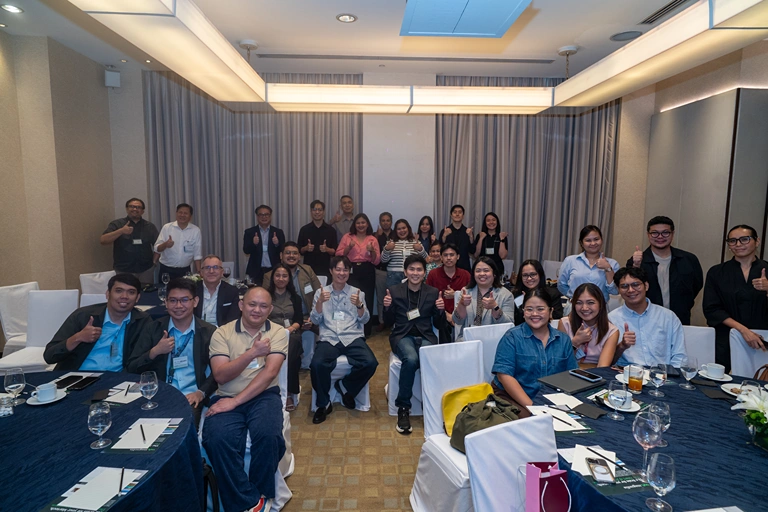
Beyond Traffic was an event hosted by Kpability and Magnolia on September 24, 2026, at Fairmont Makati, bringing…

Zoho CRM vs Odoo CRM: Which Is Better for Growing Businesses in 2026?
If you are comparing Zoho CRM and Odoo CRM, the short answer is this: Zoho CRM is the…

Odoo vs HubSpot: Which CRM Gives Growing Businesses More Value?
Odoo CRM is the better value for most growing businesses because its pricing stays predictable as teams scale…